

Everything runs on what
is behind the wall.
Electrical wiring from a single house to a factory floor, the earthing underneath it, and the protection that keeps both running through a Malaysian storm.
A house, an office,
a factory floor.
The same trade at three scales. What changes is the size of the incoming supply, the number of circuits, and how much depends on it staying on.
Houses and homes.
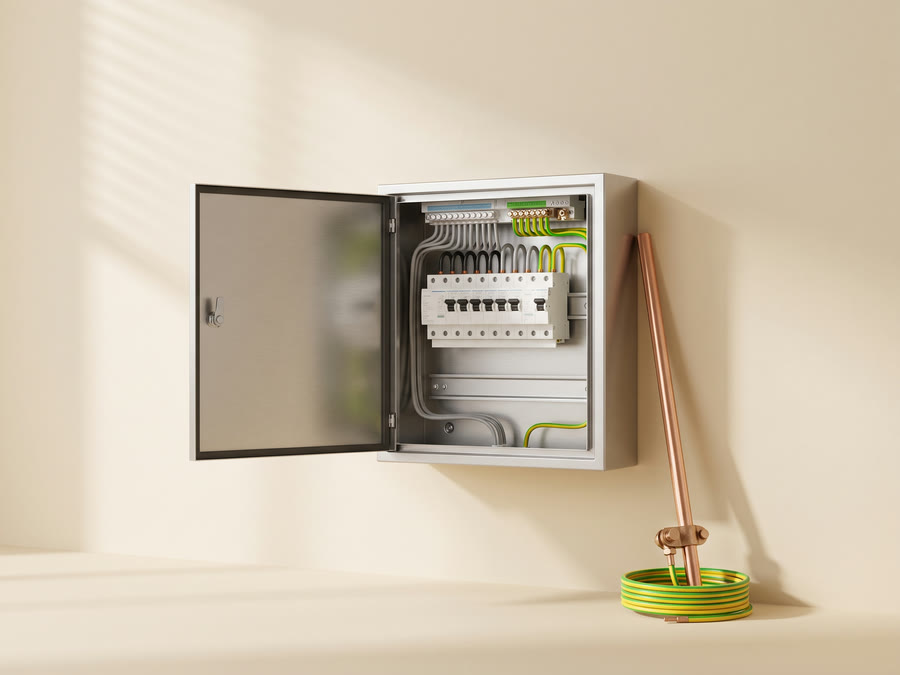
Complete wiring for a new house, or a rewire of an old one: the consumer unit, the circuits behind the plaster, the sockets and lighting, and the earth that makes all of it safe to touch.
Offices and shops.
Distribution across floors and tenancies, lighting and power layouts, and boards sized for what the building will actually draw rather than what the drawing said five years ago.
Factories and plant.
Main switchboards, machine supplies, control panels and the cable runs between them — laid out so a circuit can be worked on without stopping the line.
The part of the job
nobody ever sees.
Earthing is the only reason a fault has anywhere to go. It is buried, it is invisible, and it is the first thing we measure.
The rod goes in.
A copper-bonded electrode driven into the ground. Nothing else on this page works without it: an earth is where a fault goes when it has nowhere else to be.
And then deeper.
Rods are coupled and driven on, and more are added, until the reading comes down. How many it takes depends on the soil, which is why the number matters more than the method.
The conductor and the pit.
Bonded to the electrodes and brought back to an inspection chamber, so the connection can be opened, seen and tested again years after we have gone.
Then it is measured.
An earth tester across three spikes gives a number. On the installation in the photograph it read 6.66 ohms. We do not sign off an earth we have not measured.
The figure goes into the record with the date it was taken. Without a low-resistance earth, an SPD has nowhere to put the surge it has just diverted.
Malaysia is one of the most
lightning-struck countries on earth.
High voltage surges.
A rise of thousands of volts arrives on a line built for a few hundred. Everything after this happens in the same second.
Equipment damage.
Controllers, sensors and drives are the first things to go, because they are the things with electronics in them.
System failure.
One dead component takes the rest of the system with it. Links drop, and nothing downstream is heard from again.
Data loss.
A hole in the record exactly where the readings should have been, on the day you would most want to look at them.
Expensive repair.
Replacement parts, a call-out, and a wait for delivery, none of which were in the budget for this month.
Downtime and lost production.
The pump that did not run, the irrigation that did not happen, and the crop that noticed before anybody else did.
Fire and safety risk.
The part of the list that is not about money, and the reason none of the rest of it is optional.
Five things between the
storm and your equipment.
Power comes in, and everything after it is only as safe as whatever stands in the way. This is the order we build it in.
Power in.
From TNB or from a genset. Whatever the source, this is the point every single thing downstream depends on — and the point a surge arrives at first.
Surge protection, on power and on data.
An AC SPD on the incoming supply, and a data or signal SPD on the lines that carry readings. A surge arriving down a sensor cable does as much damage as one on the mains, and it is the one most installations forget.
The distribution panel.
Circuits split, protected and labelled, so a fault takes out one thing rather than the whole site — and so the next person can tell which is which.
The system it protects.
The controller, and everything it decides. This is what all of the above exists to keep alive.
And the devices out in the ground.
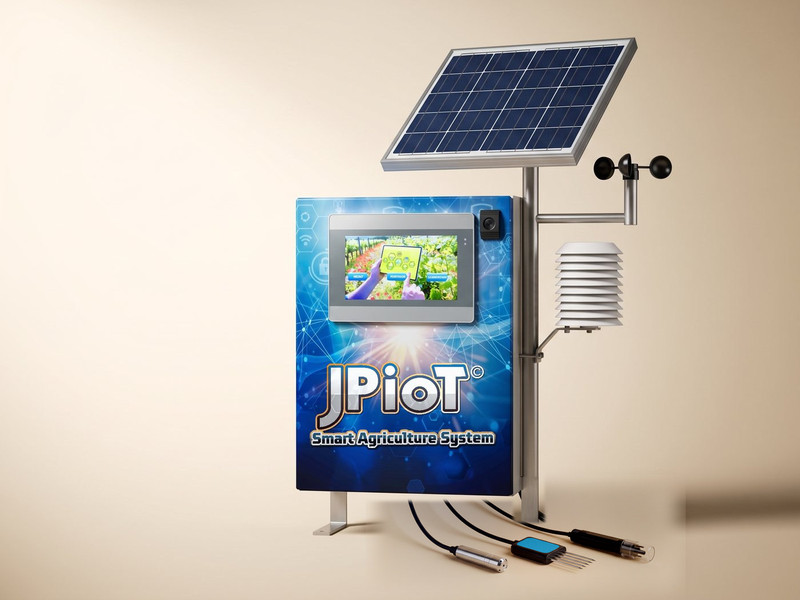
Weather station, soil sensors, EC and pH, pump controller, flow meter, valve control. Every one of them sits at the end of a cable running across open land.
All of it referenced back to the same earthing system. A diverted surge still has to go somewhere, and that somewhere is the ground under your site.
It trips. Ten seconds
later, it is back on.
A normal ELCB trips on a surge and stays off until somebody drives out to the site and pushes it back up. On a remote farm that is a day without irrigation, a stopped pump, and a gap in the record.
Running.
Power through, pump turning, sensors reporting. Nothing to look at, which is the condition you are paying for.
The surge arrives.
Lightning strikes near the line and the leakage current spikes. This is the moment everything downstream is decided.
It trips instantly.
Which is exactly right. The device does its job and cuts the power before anything behind it is damaged.
Ten seconds.
Long enough for the disturbance to have passed. Short enough that a pump, an irrigation cycle and a data log do not notice.
It closes again.
By itself. Nobody drives out to the farm, nobody climbs to the panel, nobody pushes anything back up.
Still running.
Pump back on, devices back up, the record unbroken. Twenty-four hours a day, through a season of storms.
- No power supply
- System down
- Pump stops
- Data loss
- Time and cost wasted
- Somebody has to go to the site
- Power restored automatically
- System keeps running
- Pump and devices keep working
- Data safe
- Reliable 24/7 operation
- Nobody has to go anywhere
And when the answer
is not in a catalogue.
Electrical work and IoT are the same trade here. If what you need does not exist as a product, describe the problem and we will tell you whether it can be built — and what it would take.
Something to measure.
A value you need watched that no off-the-shelf product reads the way you need it read, or in the place you need it read.
Somewhere with no network.
Sites where WiFi does not reach and a mobile signal cannot be relied on, so the reading has to travel some other way.
Two systems that do not talk.
Existing equipment that has to be read, or driven, by something newer than itself. Usually the cheapest problem on this list to solve.
Control instead of a person.
A job somebody currently drives out to do by hand, on a schedule or on a reading, and would rather not.
An alarm that actually arrives.
Reaching the right phone at the moment it matters, rather than sitting on a screen nobody was looking at until the next morning.
A record you can show.
Readings kept in a form somebody else will accept: an auditor, a buyer, an agency, or whoever asks next year.
The protection
we recommend.
What suits your site depends on what is on it. We do not put a scope on paper before seeing it.
Surge protection device.
An SPD on the incoming supply, and a second one on the data and signal lines. Two different jobs, and most installations only ever fit the first.
Auto ELCB, ten seconds.
Trips on a surge or a leakage the way any ELCB should, and then closes again by itself instead of waiting for somebody to drive out.
Proper earthing.
Electrodes, conductor, inspection chamber, and a measured reading. The one item on this list everything else depends on.
Lightning protection.
An air terminal and a down conductor, where the site and the structure call for it. Not every site does, and we will say so.
Panel protection and bonding.
The enclosure itself, its door, and every metal part of it tied back to the same earth as the equipment inside it.
Equipment isolation.
An isolator on each way out, so one device can be taken off, tested or replaced without taking the rest of the site down with it.
Suited to
Smart farming, Greenhouses, Irrigation systems, Livestock farms, Remote monitoring sites, Homes, Offices and shops, Factories and plant.